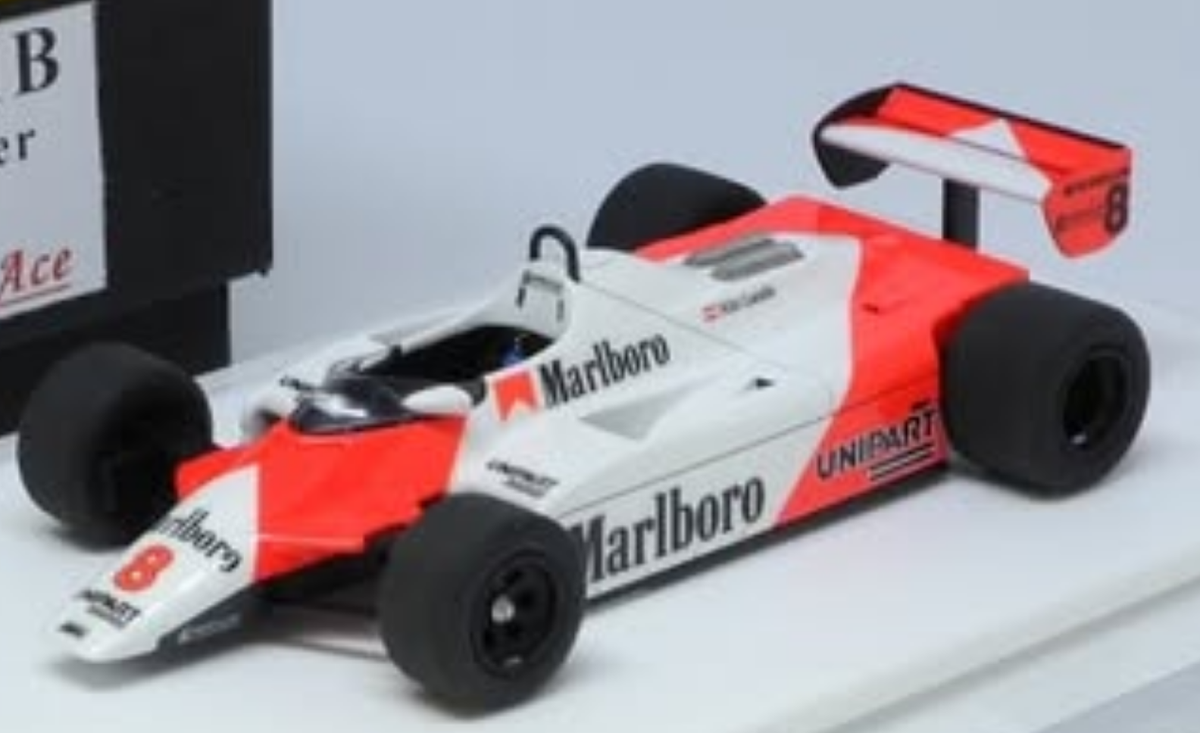
Tameo - McLaren MP4/1 G.P. British 1981 1:43 - John Watson & Andrea De Cesaris
Tameo - McLaren MP4/1 G.P. British 1981 1:43 - John Watson & Andrea De Cesaris
SKU:SLK085
Regular price
$111.34 USD
Regular price
$148.08 USD
Sale price
$111.34 USD
Unit price
per
Shipping calculated at checkout.
Couldn't load pickup availability
Product features
Product features
Tameo - McLaren MP4/1 G.P. British 1981 1:43 - John Watson & Andrea De Cesaris – Model Kit to Assemble
Relive a revolutionary moment in Formula 1 history with the Tameo Kits SLK 085, a detailed 1:43 scale replica of the legendary McLaren MP4/1, driven by John Watson and Andrea de Cesaris during the 1981 Formula 1 World Championship.
Representing Marlboro McLaren International, this model recreates the iconic white and red racing livery, featuring the recognizable Marlboro sponsorship and the original racing numbers #7 and #8.
The McLaren MP4/1 was one of the most influential racing cars ever developed, introducing a revolutionary carbon-fiber composite monocoque chassis that transformed Formula 1 engineering and driver safety.
This edition commemorates the 1981 British Grand Prix at Silverstone, where John Watson secured a memorable victory, delivering McLaren's first Grand Prix win since 1977.
The McLaren MP4/1 – A Revolution in Formula 1 Engineering
The McLaren MP4/1 was introduced in 1981 following the merger between McLaren and Project Four Racing, led by Ron Dennis.
Designed by British engineer John Barnard, the MP4/1 represented a radical departure from traditional Formula 1 construction methods.
Its most important innovation was the use of a carbon-fiber composite monocoque chassis. Unlike conventional aluminum structures, carbon fiber offered exceptional rigidity and strength while maintaining a remarkably low weight.
Although carbon-fiber components had previously appeared in motorsport, the MP4/1 was the first Formula 1 car to feature a complete carbon-fiber composite chassis.
The new construction method improved structural integrity and established an entirely new standard for racing car design.
The MP4/1 was powered by the legendary Ford Cosworth DFV 3.0-liter naturally aspirated V8 engine, one of the most successful engines in Formula 1 history.
Its aerodynamic package incorporated ground-effect principles, carefully designed sidepods, and a low-profile chassis intended to maximize downforce and improve cornering performance.
The combination of advanced materials, aerodynamic efficiency, and mechanical reliability made the MP4/1 an important milestone in the evolution of Formula 1.
Its technological influence extended far beyond the 1981 season, as rival manufacturers gradually adopted carbon-fiber monocoque construction.
The Drivers – John Watson and Andrea de Cesaris
John Watson – Car #7
Northern Irish driver John Watson was one of McLaren's most important competitors during the early 1980s.
Known for his smooth driving style, strategic intelligence, and consistency, Watson became an essential part of the team's development during its transition into the Ron Dennis era.
Driving the MP4/1, Watson demonstrated the potential of McLaren's revolutionary new chassis, achieving competitive results throughout the 1981 championship.
His most memorable achievement came at the British Grand Prix at Silverstone, where he delivered a historic victory.
Starting fifth on the grid, Watson produced an outstanding performance, taking the lead on lap 61 and securing the win seven laps later.
His victory marked McLaren's first Formula 1 Grand Prix triumph since 1977 and the first Grand Prix victory for a carbon-fiber composite Formula 1 car.
Watson finished the 1981 Drivers' Championship in sixth position with 27 points, playing a fundamental role in McLaren's return to the front of the grid.
Andrea de Cesaris – Car #8
Italian driver Andrea de Cesaris joined McLaren for the 1981 Formula 1 season, partnering John Watson.
Recognized for his natural speed and aggressive driving style, de Cesaris was one of the younger talents competing in Formula 1 during the early 1980s.
His time with McLaren provided an opportunity to compete with one of the most technologically advanced racing cars of the period.
Despite experiencing several retirements throughout the season, de Cesaris demonstrated considerable speed and secured seventh position at the Italian Grand Prix.
At the British Grand Prix, driving car #8, he was forced to retire following an accident on the third lap.
His contribution to McLaren's 1981 campaign remains part of the story behind the MP4/1 and its historic first season in Formula 1.
The 1981 Formula 1 Season – A New Era of Technology
The 1981 Formula 1 World Championship was an important transitional period in the sport, characterized by intense competition and significant technological developments.
Ground-effect aerodynamics had become increasingly sophisticated, with teams searching for ways to generate greater downforce while maintaining mechanical stability.
At the same time, turbocharged engines were becoming increasingly competitive, challenging the established naturally aspirated Ford Cosworth DFV V8 power units.
Teams such as Williams, Brabham, Ferrari, Renault, and McLaren were developing increasingly advanced racing machines.
McLaren entered the season with the MP4/1, introducing a completely new approach to chassis construction.
Although the team experienced some reliability and performance challenges during the opening races, the MP4/1 gradually demonstrated its potential.
The championship was ultimately won by Nelson Piquet driving for Brabham, finishing ahead of Carlos Reutemann and Alan Jones.
McLaren finished sixth in the Constructors' Championship with 28 points, including John Watson's important victory at Silverstone.
Despite not winning either championship, the MP4/1 established the technological foundation for McLaren's successful Formula 1 campaigns throughout the 1980s.
The 1981 British Grand Prix – A Historic Victory at Silverstone
The 1981 British Grand Prix took place on July 18 at the Silverstone Circuit in England, representing one of the defining moments of McLaren's modern Formula 1 history.
John Watson qualified fifth, while teammate Andrea de Cesaris started sixth.
During the race, Watson delivered an impressive performance, gradually advancing through the field as competing cars encountered difficulties.
On lap 61, Watson moved into the lead, overtaking Carlos Reutemann's Williams.
Seven laps later, he crossed the finish line to secure victory after 68 laps, finishing 40.650 seconds ahead of Reutemann.
This result represented McLaren's first Grand Prix victory since the 1977 Japanese Grand Prix and the first victory for a Formula 1 car featuring a complete carbon-fiber composite monocoque.
Unfortunately, Andrea de Cesaris was unable to finish the race after an accident on lap three.
The British Grand Prix became a landmark event for McLaren, demonstrating that its revolutionary engineering concept could deliver both competitive performance and exceptional structural strength.
The McLaren MP4/1 – Distinctive Design and Racing Identity
The MP4/1 introduced a completely new visual and technical identity for McLaren.
Its recognizable white bodywork with red Marlboro graphics became one of the most iconic Formula 1 liveries of the early 1980s.
The car featured a narrow central monocoque, sculpted sidepods, exposed suspension components, and aerodynamic wings designed to maximize performance.
The Marlboro branding dominated the bodywork, creating the distinctive red-and-white appearance associated with McLaren during this period.
The combination of advanced carbon-fiber construction and traditional mechanical engineering made the MP4/1 an important bridge between the Formula 1 cars of the 1970s and the increasingly sophisticated machines of the 1980s.
Product Details
• Manufacturer: Tameo Kits
• Product Reference: SLK 085
• Vehicle: McLaren MP4/1
• Team: Marlboro McLaren International
• Race: British Grand Prix 1981
• Circuit: Silverstone Circuit, England
• Drivers: John Watson (#7) and Andrea de Cesaris (#8)
• Scale: 1:43
• Engine: Ford Cosworth DFV 3.0-liter V8
• Main Body Color: White – Tamiya TS-26
• Racing Livery: White and Red
• Main Sponsor: Marlboro
• Product Line: SLK SilverLine
• Product Type: White Metal Model Kit
• Assembly Required: Yes
• Recommended for: Formula 1 enthusiasts, McLaren collectors, and historic motorsport model builders
Kit Features and Components
The Tameo Kits SLK 085 belongs to the manufacturer's SilverLine collection, offering collectors a detailed 1:43 scale reproduction of the revolutionary McLaren MP4/1.
The SilverLine range was developed to provide an accessible model-building experience while maintaining the precision and craftsmanship associated with Tameo Kits.
These kits are manufactured using a combination of traditional white metal casting and precision-made components, allowing enthusiasts to recreate historic Formula 1 cars in miniature.
The SLK range typically consists of approximately 100 components, combining different materials and manufacturing techniques to achieve an accurate reproduction.
Typical kit components include:
• White metal body and main structural components.
• White metal lower body and chassis components.
• Photo-etched metal parts for enhanced detailing.
• Aluminum and turned brass components.
• Precision-made wheel rims and brake details.
• Real rubber tires.
• Water-slide decals featuring the original racing livery and sponsor markings.
• Full-color assembly instructions.
The combination of white metal casting, photo-etched components, and precision-machined details allows model builders to recreate the distinctive appearance of the McLaren MP4/1.
Please note that paints and adhesives are not included and must be purchased separately.
An Essential Addition to Any Formula 1 Collection
The McLaren MP4/1 represents one of the most important technological breakthroughs in Formula 1 history.
Its revolutionary carbon-fiber monocoque changed the way racing cars were designed and constructed, establishing engineering principles that remain fundamental to modern motorsport.
The 1981 British Grand Prix configuration is particularly significant because it represents John Watson's historic victory at Silverstone and the beginning of McLaren's return to championship-winning form.
Whether you are a dedicated McLaren supporter, a John Watson enthusiast, or a collector of historic Formula 1 machinery, the Tameo Kits SLK 085 offers an excellent opportunity to recreate one of the most influential racing cars ever built.
Build a piece of Formula 1 history with the revolutionary McLaren MP4/1.