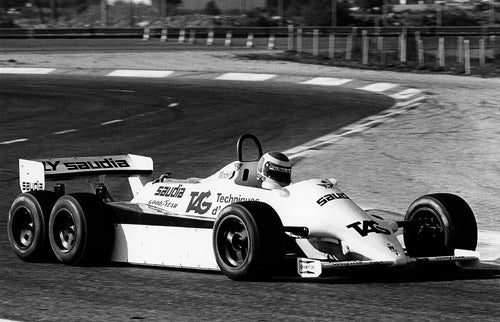
Tameo - Williams FW-07D Ford - Test Version 1981 (1:43) Scale
Tameo - Williams FW-07D Ford - Test Version 1981 (1:43) Scale
SKU:SLK065
Regular price
$126.15 USD
Regular price
$167.78 USD
Sale price
$126.15 USD
Unit price
per
Shipping calculated at checkout.
Couldn't load pickup availability
Product features
Product features
Tameo – 1:43 Williams Ford FW07D Six-Wheeler – Paul Ricard Test 1981 – Model Kit to Assemble
Discover one of the most unusual and fascinating engineering experiments in Formula 1 history with this detailed 1:43 scale Tameo Kits model of the Williams Ford FW07D, the experimental six-wheeled racing car developed by Williams during the 1981 season.
Featuring its distinctive white bodywork and unconventional six-wheel configuration, the FW07D represents an ambitious attempt to improve traction, aerodynamic efficiency, and overall performance. Powered by the legendary Ford Cosworth DFV V8 engine, this experimental machine remains one of the most intriguing designs ever developed for Formula 1.
The History of the Williams FW07D
Developed under the technical direction of Patrick Head, with important contributions from engineer Frank Dernie, the Williams FW07D was created as an alternative solution to the growing performance advantage of turbocharged Formula 1 engines.
The concept was based on reducing aerodynamic drag while improving mechanical grip. Instead of the conventional two rear wheels, Williams introduced four smaller driven rear wheels arranged across two axles, while retaining two front wheels.
The additional rear wheels were designed to increase traction and distribute the car's power more effectively. The smaller rear tyres also reduced aerodynamic resistance, potentially providing a significant advantage on high-speed circuits.
The FW07D underwent testing in 1981, including sessions at Paul Ricard in France. Australian driver Alan Jones was among the first to test the experimental six-wheeler at Donington Park, while Keke Rosberg also drove the concept during subsequent testing.
Despite promising performance and impressive traction, the project was never developed into a race-winning Formula 1 car. The technical challenges and regulatory changes eventually led to the abandonment of the six-wheel concept, with the FIA formally banning six-wheeled cars from Formula 1 competition from 1983.
Although it never competed in an official Grand Prix, the FW07D remains a fascinating example of Williams' innovative engineering philosophy and willingness to explore unconventional solutions.
The Drivers and Development Team
Alan Jones
Alan Jones was the 1980 Formula 1 World Champion and one of Williams' most successful drivers. He played an important role in the development of the FW07D, testing the six-wheeled prototype shortly after winning the 1981 Caesars Palace Grand Prix in Las Vegas. His feedback helped Williams evaluate the potential of the unusual configuration.
Keke Rosberg
Keke Rosberg was another important driver associated with Williams' six-wheel development programme. He tested the experimental concept at Paul Ricard in 1981, contributing valuable feedback on its handling and performance. Rosberg would later become the 1982 Formula 1 World Champion with Williams.
Patrick Head and Frank Dernie
The FW07D project was driven by the technical vision of Patrick Head and the aerodynamic expertise of Frank Dernie. Their work demonstrated Williams' determination to find innovative solutions to the performance challenges of the early 1980s.
Model Kit Details
• Manufacturer: Tameo Kits
• Product Code: SLK 065
• Scale: 1:43
• Car: Williams FW07D Six-Wheeler
• Engine: Ford Cosworth DFV V8
• Version: Experimental Test Car
• Testing Location: Paul Ricard, France
• Year: 1981
• Main Color: White (Tamiya TS-26)
• Product Type: Model Kit to Assemble
A Unique Addition to Your Collection
This Tameo Kits 1:43 scale model kit is an excellent choice for Formula 1 enthusiasts, motorsport historians, and collectors interested in unusual racing car designs and experimental engineering projects.
Its distinctive six-wheel configuration, classic Williams design, and historical significance make it a particularly interesting addition to any Formula 1 collection.
More than just a model of a racing car, the Williams FW07D represents a fascinating chapter in motorsport innovation, celebrating an era when engineers dared to challenge conventional Formula 1 design.