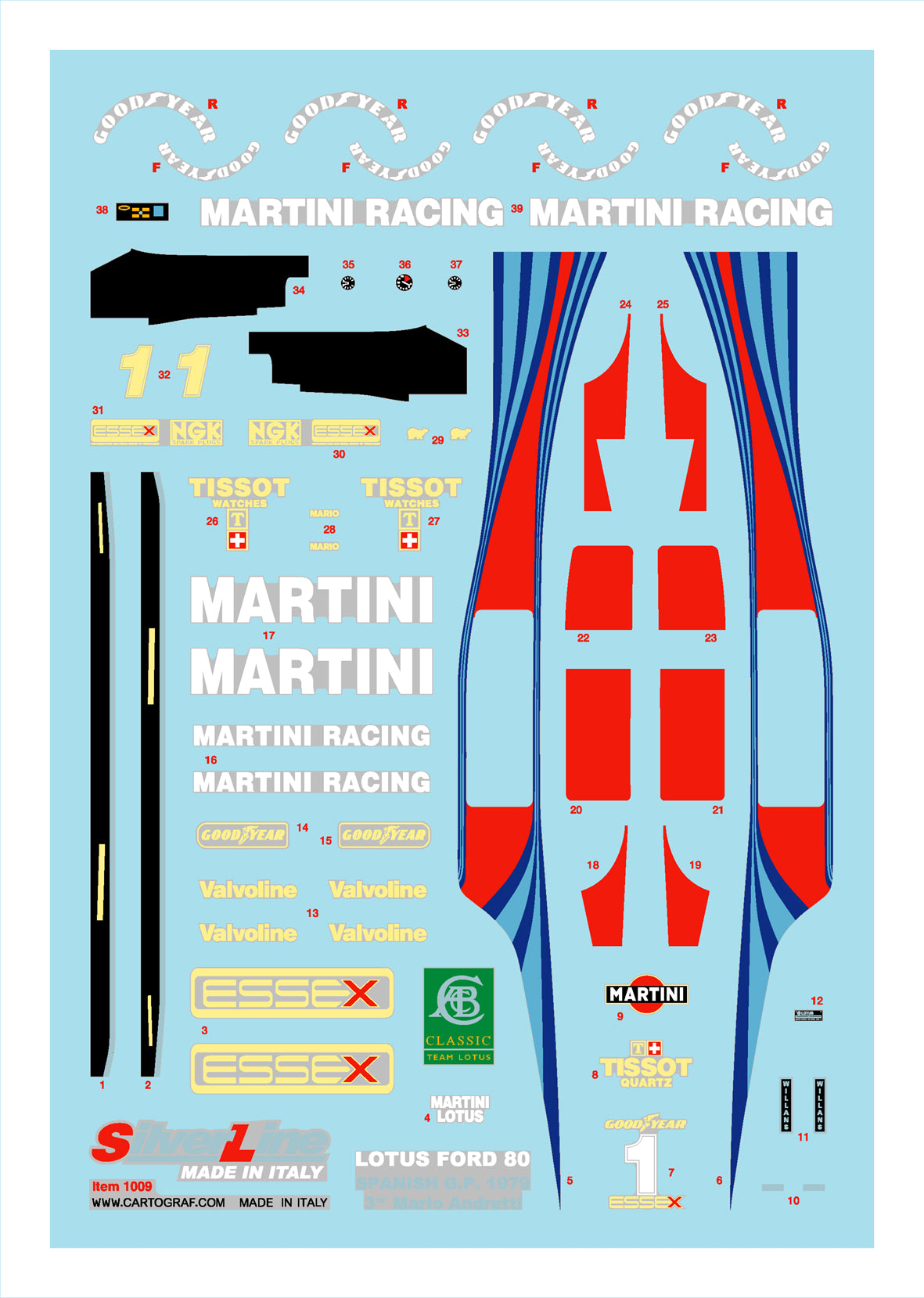
Tameo - Lotus 80 Ford Cosworth G.P Spagna 1979 1:43 - Mario Andretti
Tameo - Lotus 80 Ford Cosworth G.P Spagna 1979 1:43 - Mario Andretti
SKU:SLK041
Regular price
$111.38 USD
Regular price
$222.75 USD
Sale price
$111.38 USD
Unit price
per
Shipping calculated at checkout.
Couldn't load pickup availability
Product features
Product features
Tameo - Lotus 80 Ford Cosworth G.P Spagna 1979 1:43 - Mario Andretti – Model Kit to Assemble
Discover one of the most ambitious Formula 1 engineering projects of the late 1970s with the Tameo Kits SLK 041, a detailed 1:43 scale replica of the Lotus 80, driven by Mario Andretti during the 1979 Spanish Grand Prix.
Representing Team Lotus, this model recreates the distinctive Lotus 80 design, featuring its innovative ground-effect aerodynamic concept and characteristic green bodywork.
The Lotus 80 was developed as an evolution of the revolutionary Lotus 79, which had dominated the 1978 Formula 1 season. Designed to take ground-effect aerodynamics to an entirely new level, the car represented Colin Chapman's ambition to create an even more aerodynamically efficient racing machine.
This edition commemorates the Spanish Grand Prix at Jarama in April 1979, where Mario Andretti finished third, securing a podium finish in the Lotus 80's Formula 1 debut.
The Lotus 80 – An Ambitious Engineering Revolution
The Lotus 80 was designed for the 1979 Formula 1 season as the successor to the championship-winning Lotus 79.
Under the direction of legendary designer Colin Chapman, the Lotus engineering team sought to maximize the ground-effect aerodynamic principles that had transformed Formula 1 during the previous season.
The design team included Colin Chapman, Martin Ogilvie, Peter Wright, and Tony Rudd, who worked together to develop a car capable of generating extraordinary levels of aerodynamic downforce.
Unlike conventional Formula 1 cars, the Lotus 80 was designed to extend the ground-effect concept along almost the entire underside of the vehicle, from the front section to beyond the rear wheels.
Its aerodynamic bodywork incorporated specially shaped underbody tunnels and sealing skirts designed to create a powerful low-pressure area beneath the chassis.
This aerodynamic configuration was intended to generate substantial downforce without relying exclusively on large conventional wings, potentially allowing the car to achieve greater cornering speeds and improved aerodynamic efficiency.
The Lotus 80 was powered by the legendary Ford Cosworth DFV 3.0-liter naturally aspirated V8 engine, one of the most successful power units in Formula 1 history.
Despite its innovative design, the Lotus 80 proved difficult to control. Its extreme aerodynamic characteristics created instability and unpredictable handling, particularly when the aerodynamic balance changed during cornering and over uneven surfaces.
These problems prevented the car from achieving the competitive advantage Chapman had originally envisioned. Nevertheless, the Lotus 80 remains an important example of the experimental engineering philosophy that defined Team Lotus during the ground-effect era.
Mario Andretti – The American Formula 1 World Champion
Mario Andretti was one of the most versatile and successful racing drivers in motorsport history. Born in Italy in 1940, he moved to the United States as a child and eventually became one of the most celebrated figures in international racing.
Andretti competed in several major motorsport categories, including Formula 1, IndyCar, NASCAR, and endurance racing, achieving remarkable success throughout his career.
His Formula 1 career reached its peak in 1978, when he won the World Drivers' Championship with Team Lotus, driving the revolutionary Lotus 79.
Entering the 1979 season as the reigning World Champion, Andretti was entrusted with developing and racing the ambitious new Lotus 80.
Despite the technical difficulties associated with the car, Andretti demonstrated his experience and driving ability throughout the season.
At the Spanish Grand Prix, he secured third position, delivering a podium finish during the Lotus 80's first Formula 1 appearance.
Andretti remains one of the most important drivers in Lotus history and one of the few competitors to achieve major victories in multiple motorsport disciplines.
The 1979 Formula 1 Season – The Evolution of Ground Effect
The 1979 Formula 1 World Championship represented an important period of technological development, as teams continued exploring the aerodynamic advantages introduced by ground-effect technology.
Following Lotus's dominant 1978 campaign, competing manufacturers invested heavily in developing cars capable of generating greater aerodynamic downforce through their underbody designs.
Team Lotus entered the season with high expectations, introducing the Lotus 80 as its latest technological innovation.
However, the competition was stronger than ever. Teams such as Ferrari, Ligier, Williams, and Renault were developing increasingly sophisticated racing machines.
Ferrari introduced the 312T4, while Ligier enjoyed considerable success with the JS11. Renault continued developing its turbocharged engine technology, introducing an alternative approach to Formula 1 performance.
The championship was ultimately won by Jody Scheckter with Ferrari, followed by Gilles Villeneuve, while Alan Jones secured third place for Williams.
Although the Lotus 80 did not become the championship-winning machine Chapman had hoped for, its development contributed to the ongoing evolution of Formula 1 aerodynamic engineering.
The 1979 Spanish Grand Prix – Lotus 80's Formula 1 Debut
The 1979 Spanish Grand Prix took place on April 29 at the Circuito Permanente del Jarama, near Madrid.
The race was the fifth round of the 1979 Formula 1 World Championship and marked the competitive debut of the Lotus 80.
Mario Andretti qualified fourth, demonstrating that the new car had considerable potential despite its technical challenges.
During the race, Andretti maintained a competitive pace and completed the 75-lap event in third position.
The race was won by French driver Patrick Depailler in the Ligier-Ford JS11, with Carlos Reutemann finishing second in the Lotus 79.
Andretti completed the podium, finishing 27.310 seconds behind the winner and collecting four championship points.
The result was particularly significant because it demonstrated that the Lotus 80 could compete at the front of the field, even though its aerodynamic behavior would become increasingly problematic during subsequent races.
The Spanish Grand Prix therefore represents an important moment in the history of the Lotus 80, marking the beginning of one of Team Lotus's most ambitious engineering experiments.
The Lotus 80's Distinctive Design and Engineering
The Lotus 80 featured an extremely low-profile aerodynamic body designed to maximize the ground-effect phenomenon.
Its most distinctive characteristic was the extensive underbody aerodynamic system, which aimed to generate downforce across a much larger portion of the car than previous designs.
The car also incorporated carefully designed side sections, aerodynamic skirts, and a sophisticated suspension arrangement intended to maintain a consistent distance between the chassis and the track surface.
Its lightweight construction and Ford Cosworth DFV engine reflected the engineering philosophy that had made Team Lotus one of the most innovative manufacturers in Formula 1.
The combination of aerodynamic experimentation and mechanical engineering made the Lotus 80 a fascinating machine, even though its performance ultimately fell short of expectations.
Product Details
• Manufacturer: Tameo Kits
• Product Reference: SLK 041
• Vehicle: Lotus 80
• Team: Team Lotus
• Race: Spanish Grand Prix 1979
• Circuit: Circuito Permanente del Jarama, Spain
• Driver: Mario Andretti
• Racing Number: #1
• Scale: 1:43
• Engine: Ford Cosworth DFV 3.0-liter V8
• Main Body Color: Green – Tamiya TS-28 / RAL 6028 reference
• Racing Livery: Green
• Tires: Goodyear
• Product Line: SLK SilverLine
• Product Type: White Metal Model Kit
• Assembly Required: Yes
• Recommended for: Formula 1 enthusiasts, Lotus collectors, and historic motorsport model builders
Kit Features and Components
The Tameo Kits SLK 041 belongs to the manufacturer's SilverLine collection, offering collectors a detailed 1:43 scale reproduction of the innovative Lotus 80.
The SilverLine range was developed to provide an accessible model-building experience while maintaining the precision and craftsmanship associated with Tameo Kits.
These kits are manufactured using a combination of traditional white metal casting and precision-made components, allowing enthusiasts to recreate historic Formula 1 cars in miniature.
The SLK range typically consists of approximately 100 components, combining different materials and manufacturing techniques to achieve an accurate reproduction.
Typical kit components include:
• White metal body and main structural components.
• White metal lower body and chassis components.
• Photo-etched metal parts for enhanced detailing.
• Aluminum and turned brass components.
• Precision-made wheel rims and brake details.
• Real rubber tires.
• Water-slide decals featuring the original racing markings.
• Full-color assembly instructions.
The combination of white metal casting, photo-etched components, and precision-machined details allows model builders to recreate the distinctive aerodynamic appearance of the Lotus 80.
Please note that paints and adhesives are not included and must be purchased separately.
An Essential Addition to Any Formula 1 Collection
The Lotus 80 represents one of the most fascinating experimental projects in Formula 1 history. Its radical aerodynamic concept demonstrated Colin Chapman's ambition to push the boundaries of racing car design.
The 1979 Spanish Grand Prix configuration is particularly significant because it represents the car's competitive debut, driven by reigning World Champion Mario Andretti.
Although the Lotus 80 never achieved the success of its predecessor, the Lotus 79, it remains an important piece of the technological evolution of Formula 1.
Whether you are a dedicated Team Lotus supporter, a Mario Andretti fan, or a collector of historic Formula 1 machinery, the Tameo Kits SLK 041 offers an excellent opportunity to recreate one of the most unusual racing cars of the ground-effect era.
Build a piece of Formula 1 history with the innovative Lotus 80.