Italeri - Cant Z.501 Gabbiano 1:72 Scale
Italeri - Cant Z.501 Gabbiano 1:72 Scale
SKU:ITA112
Regular price
$62.99 USD
Regular price
$31.49 USD
Sale price
$62.99 USD
Unit price
per
Shipping calculated at checkout.
Couldn't load pickup availability
Product features
Product features
Italeri 1:72 CANT Z.501 Gabbiano – Model Kit to Assemble
At 1:72 scale, Italeri’s CANT Z.501 Gabbiano measures 19.9 cm (7.8 inches) long and recreates one of Italy’s most distinctive maritime reconnaissance aircraft of World War II. The kit features detailed aircraft components, colorful assembly instructions, and decals for four different versions, allowing modelers to represent this unusual Italian seaplane in a variety of historical markings.
Designed during the 1930s, the CANT Z.501 Gabbiano was developed for maritime reconnaissance, coastal patrol, and search-and-rescue operations. Its distinctive high-mounted wing, central boat-shaped hull, and stabilizing floats gave it a characteristic appearance, reflecting the specialized requirements of an aircraft designed to operate from the sea.
Powered by an Isotta Fraschini Asso XI engine, the Gabbiano served with the Italian Regia Aeronautica during World War II, particularly in the Mediterranean theater. Italeri’s model captures the unusual configuration of this flying boat and offers aviation enthusiasts an opportunity to explore a lesser-known chapter of Italian military aviation.
The Gabbiano – Italy’s Maritime Watchkeeper
The CANT Z.501 was designed by Filippo Zappata for Cantieri Riuniti dell’Adriatico (C.R.D.A.), an Italian company with experience in shipbuilding and aircraft construction. Developed during the 1930s, the aircraft reflected Italy’s need for a specialized platform capable of conducting reconnaissance and patrol missions over extensive maritime areas.
The aircraft’s name, Gabbiano, means “seagull” in Italian, an appropriate name for a seaplane designed to operate over coastal waters and open sea.
Unlike conventional land-based aircraft, the Z.501 featured a central boat-shaped fuselage that allowed it to land and take off from water. Stabilizing floats mounted beneath the wings helped maintain balance while the aircraft was on the surface.
Its large, high-mounted wing provided the lift required for maritime operations, while its overall configuration was designed around the practical demands of long patrol flights over the Mediterranean.
The Gabbiano was not intended to compete with frontline fighters or conventional bombers. Instead, its primary value came from its ability to observe maritime activity, search for vessels, and support operations over water.
These specialized duties made the CANT Z.501 an important example of the different aircraft types employed by the Italian armed forces during the Second World War.
A Seaplane Built for Maritime Operations
The CANT Z.501’s most distinctive feature was its boat-shaped central hull. This design allowed the aircraft to operate directly from suitable bodies of water without requiring a conventional runway.
The hull served as the aircraft’s main structure and provided the buoyancy necessary for water operations. Its shape was essential to the aircraft’s ability to move across the surface during takeoff and landing.
The high-mounted wing and supporting structure gave the Gabbiano its characteristic silhouette. Beneath the wings, stabilizing floats helped prevent excessive rolling while the aircraft was afloat.
This configuration reflected the engineering challenges involved in designing an aircraft that had to function both as a flying machine and as a seaworthy platform.
Compared with land-based aircraft, flying boats required special consideration for water resistance, stability, and the structural stresses associated with repeated contact with the surface.
The result was an aircraft that looked quite different from conventional military bombers and fighters of the same period. Its unusual proportions make the CANT Z.501 an especially interesting subject for scale modelers.
Italeri’s 1:72 scale model reproduces the Gabbiano’s recognizable boat-shaped fuselage, high wing, and distinctive float arrangement, making it an excellent addition to a collection of historical seaplanes and maritime patrol aircraft.
Powered by the Isotta Fraschini Asso XI
The CANT Z.501 was powered by an Isotta Fraschini Asso XI engine rated at approximately 900 horsepower. This powerplant provided the performance required for maritime reconnaissance and patrol operations.
According to Italeri, the aircraft could reach a maximum speed of approximately 275 km/h (171 mph). Although this was modest compared with the performance of contemporary fighter aircraft, speed was only one consideration for a machine designed primarily for observation and operations over water.
The Gabbiano’s mission depended on its ability to remain airborne, cover maritime areas, and perform reconnaissance duties rather than engage enemy aircraft in conventional dogfights.
Its design therefore prioritized operational suitability for maritime missions. The aircraft’s water-operating capability was particularly valuable in regions where suitable airfields were limited or where patrols needed to be conducted from coastal bases.
The combination of its engine, wing configuration, and flying-boat hull gave the Gabbiano the characteristics required for its specialized role in Italian aviation.
Maritime Reconnaissance and Coastal Patrol
Maritime reconnaissance was an essential military activity during World War II. Naval forces needed information about enemy shipping, coastal movements, and potential threats to friendly vessels and installations.
Aircraft such as the CANT Z.501 could patrol over large stretches of water, searching for ships and reporting observations to the appropriate military authorities. Their ability to operate from water made them particularly suitable for certain coastal and island environments.
Search-and-rescue duties were another important aspect of the Gabbiano’s intended role. Operating over the sea inevitably involved the risk of aircraft or vessel crews being lost or forced into the water, creating a need for aircraft capable of searching maritime areas.
The Z.501 was designed to undertake these kinds of missions, combining reconnaissance capabilities with the practical advantages of a flying boat.
During wartime, however, maritime patrol aircraft could also face threats from enemy fighters and other hostile forces. The Gabbiano was equipped with three 7.7 mm Breda-SAFAT machine guns for defensive purposes.
It could also carry a limited offensive load, although its primary role remained reconnaissance and patrol rather than heavy attack.
The CANT Z.501 illustrates how military aviation included a wide variety of specialized aircraft, each designed to fulfill a particular operational requirement beyond the better-known roles of fighters and bombers.
The CANT Z.501 During World War II
The CANT Z.501 began its operational career during the Spanish Civil War before becoming widely employed by the Italian Regia Aeronautica during World War II.
Its wartime service was concentrated largely in the Mediterranean theater, where maritime reconnaissance and patrol operations were important to the military situation.
The Mediterranean was a strategically significant region during the conflict. Its shipping routes connected military bases, ports, islands, and territories controlled by the opposing sides. Monitoring activity over these waters was therefore an important responsibility for Italian military aviation.
The Gabbiano’s ability to operate from water allowed it to fulfill missions that differed from those assigned to conventional land-based aircraft. Its duties could involve searching for maritime activity, observing coastal areas, and supporting broader naval operations.
The aircraft’s relatively modest speed and defensive armament reflected the challenges faced by reconnaissance seaplanes operating in a theater increasingly dominated by more capable combat aircraft.
Despite these limitations, the CANT Z.501 became an important part of Italy’s maritime aviation history. Its long, distinctive hull and high wing made it immediately recognizable among the aircraft operating over the Mediterranean.
For military aviation enthusiasts, the Gabbiano provides a fascinating subject that goes beyond the familiar fighters and bombers of World War II, highlighting the importance of reconnaissance, patrol, and rescue missions.
A Specialized Aircraft in the Mediterranean Theater
The Mediterranean presented unique challenges for military aviation during World War II. Long coastlines, numerous islands, busy shipping routes, and strategically important ports created a constant need for observation and maritime patrol.
Aircraft operating in this environment had to cover large areas while dealing with changing weather, long distances, and the possibility of encountering enemy forces.
Flying boats offered certain operational advantages because they could use suitable stretches of water rather than relying entirely on conventional airfields. This capability could be valuable in coastal regions and locations where runway infrastructure was limited.
The CANT Z.501 was designed around these requirements. Its boat-shaped fuselage enabled water operations, while its high wing and stabilizing floats reflected the particular demands of seaplane engineering.
Although it was not as heavily armed or as fast as frontline combat aircraft, the Gabbiano fulfilled a different function within the wider military system. Reconnaissance and patrol aircraft contributed information that could support operational planning and maritime awareness.
Its history demonstrates that successful military aviation depended not only on fighters and bombers but also on specialized aircraft designed for observation, communication, transport, and rescue.
A Distinctive Subject for Aircraft Modelers
The CANT Z.501 Gabbiano stands out from conventional aircraft models because of its unusual flying-boat configuration. Its long central hull, high-mounted wing, external floats, and single-engine layout create a silhouette unlike that of most land-based military aircraft.
At 19.9 cm (7.8 inches) long, the completed model offers a manageable display size while retaining the distinctive proportions of the original aircraft.
The large wing surfaces and central hull provide opportunities for careful painting and finishing. Modelers can pay particular attention to the transition between the fuselage and wing, the engine installation, the stabilizing floats, and the aircraft’s maritime configuration.
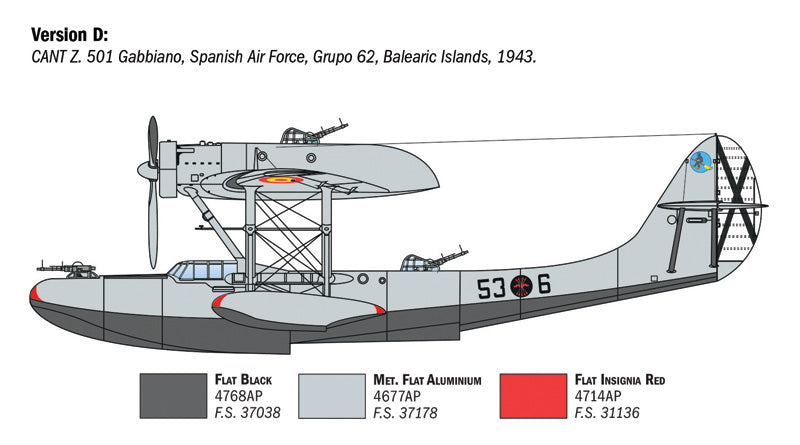
The four decal options allow collectors to explore different historical presentations of the Gabbiano. Italeri also provides color assembly instructions and recommends several paint colors for finishing the model.
Depending on the selected version and preferred modeling style, the finished aircraft can be presented with a clean appearance or subtle weathering to suggest the effects of exposure to saltwater, sun, and demanding maritime operations.
The CANT Z.501 is an excellent choice for collectors who want to expand beyond conventional fighters and bombers. It also pairs naturally with other Italian aircraft from the same period or with models representing the history of maritime aviation.
Whether displayed independently or as part of a broader World War II collection, the Gabbiano offers a distinctive representation of Italy’s specialized military aviation during the conflict.
Kit Features and Specifications
Manufacturer: Italeri
Manufacturer’s item number: 0112
Aircraft: CANT Z.501 Gabbiano
Scale: 1:72
Finished length: 19.9 cm (7.8 inches)
Aircraft type: Maritime reconnaissance flying boat
Historical period: World War II
Country: Italy
Engine: Isotta Fraschini Asso XI, approximately 900 hp
Maximum speed: Approximately 275 km/h (171 mph)
Defensive armament of the original aircraft: Three 7.7 mm Breda-SAFAT machine guns
Skill level: 2 – Beginner to intermediate
Decals: Markings for 4 versions
Instructions: Color assembly instructions
Suggested paints: Includes manufacturer-recommended colors for finishing the model.
Construction: Plastic model kit to assemble.
A Unique Addition to an Italian Aviation Collection
The CANT Z.501 Gabbiano is an excellent choice for modelers interested in Italian military aviation, World War II maritime operations, and the development of specialized seaplanes.
Its distinctive boat-shaped fuselage and high-mounted wing make it immediately recognizable, while its history offers a different perspective on the aircraft used during the conflict.
Unlike conventional fighters and bombers, the Gabbiano was designed primarily for reconnaissance, coastal patrol, and search-and-rescue duties. These missions played an important role in supporting maritime operations across the Mediterranean.
Italeri’s 1:72 scale CANT Z.501 Gabbiano provides an opportunity to recreate this unusual aircraft in a compact display format. Its four marking options offer flexibility for collectors, while its distinctive configuration makes it stand out in a collection of historical aircraft.
Whether you specialize in Italian aviation, seaplanes, or lesser-known aircraft of World War II, the Gabbiano is a rewarding subject that combines unusual engineering with a compelling operational history.
Assembly and Painting Information
This product is a plastic model kit that requires assembly and painting. It is supplied unassembled and is not a finished display aircraft.
Paints, modeling glue, and tools may be required to complete the model and are not included unless specifically stated by the manufacturer.
The kit includes color assembly instructions and decals for four versions. Please consult the instructions for assembly guidance, recommended paint colors, and decal placement.
Recommended for modelers who enjoy building historical aircraft and exploring the specialized designs developed during World War II.