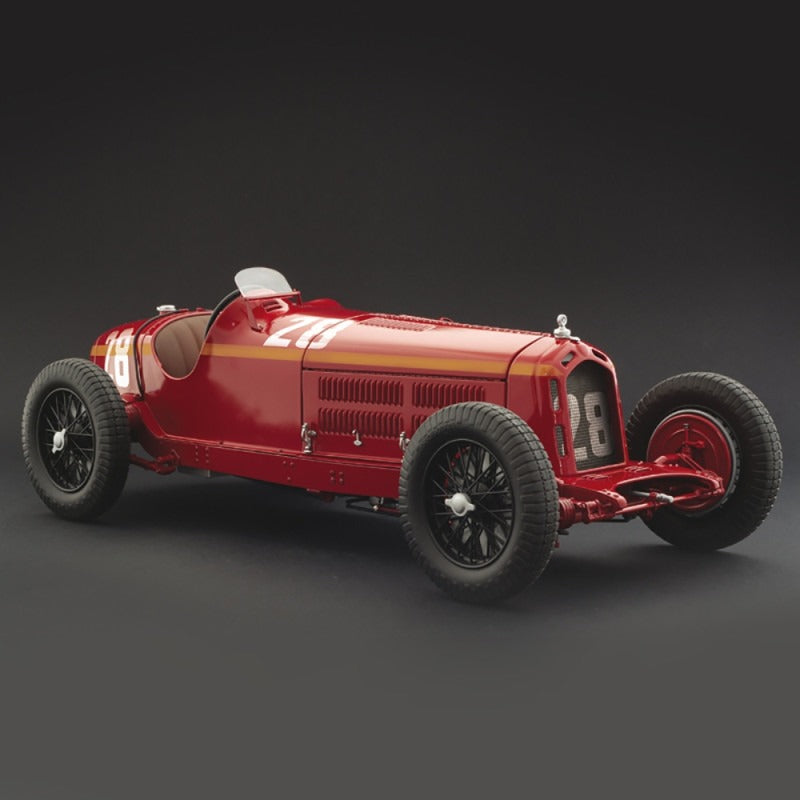
Italeri 4706 - Alfa Romeo 8C 2300 Monza 1:12 Scale
Italeri 4706 - Alfa Romeo 8C 2300 Monza 1:12 Scale
SKU:ITA4706
Regular price
$150.00 USD
Regular price
$299.99 USD
Sale price
$150.00 USD
Unit price
per
Shipping calculated at checkout.
Couldn't load pickup availability
Product features
Product features
The Alfa That Earned Its Name
The Alfa Romeo 8C 2300 Monza earned the name by winning at Monza.
In 1931, Giuseppe Campari and Tazio Nuvolari drove Alfa Romeo’s new 8C 2300 to victory in the Italian Grand Prix. The shortened, competition-focused version of the car thereafter became known simply as the “Monza.”
It was a racing machine of exceptional beauty, formidable performance and almost complete indifference to comfort. This was reasonable. Comfort had not entered the race.
Designed by Vittorio Jano
The 8C 2300 was created under Vittorio Jano, one of the most influential automobile engineers of the period.
At its heart was a supercharged 2,336cc straight-eight engine. The long powerplant was divided into two four-cylinder blocks, with a central gear train driving the twin overhead camshafts, supercharger and accessories.
This arrangement reduced stress within the engine while providing impressive power and reliability. Competition versions initially produced approximately 155 horsepower, with later development raising output to around 165 horsepower.
In a lightweight open car with narrow tires and mechanical drum brakes, that was quite sufficient.
Possibly more than sufficient.

Shorter, Lighter and Built to Race
The Monza was developed from the short-wheelbase 8C 2300 Spider Corsa.
Compared with the touring Roadster, it dispensed with such extravagances as full fenders, running boards and meaningful protection from the weather. Its narrow two-seat body sat on an exposed ladder-frame chassis, with the fuel tank at the rear and a large side exhaust running beside the cockpit.
The second seat could accommodate a riding mechanic, a requirement in some long-distance events. His duties included monitoring the car, assisting the driver and remaining remarkably calm while sitting inches from a supercharged engine’s exhaust.
Modern racing teams generally provide their mechanics with chairs farther away.
Victories Across Europe
The 8C 2300 became one of the dominant competition cars of the early 1930s.
Tazio Nuvolari drove an 8C 2300 to victory in the Targa Florio. The model also won the Mille Miglia in 1932 and 1933, while its long-wheelbase Le Mans relative won the 24-hour race four consecutive times from 1931 through 1934.
Many 8C 2300s were prepared and entered by Scuderia Ferrari, then operating as Alfa Romeo’s racing organization. This was before Ferrari began building its own cars, back when the prancing horse was attached to an Alfa Romeo and nobody found this confusing.
The Monza remained competitive in the hands of factory drivers, private entrants and some of the greatest names in prewar motor racing.
More Than 330 Large-Scale Parts
Italeri’s impressive 1:12 scale kit recreates the purposeful two-seat Monza with a complete chassis, drivetrain, suspension and supercharged engine.
The kit contains 300 plastic parts and 30 chrome-plated components, together with photo-etched details, rubber tires, metal screws, flexible tubing, wire, cord and nylon mesh.
When complete, the model measures approximately 32 cm, or 12.6 inches, in length. It is large enough to display the mechanical character of the original car in considerable detail—and large enough that anything assembled crookedly will have nowhere to hide.

A Complete Supercharged Straight-Eight
The kit’s centerpiece is the highly detailed 2.3-liter straight-eight engine.
Separate components reproduce the twin engine blocks, camshaft housings, Roots-type supercharger, intake manifold, exhaust manifold, gearbox and accessories. Flexible tubing and wire are supplied for ignition leads, fluid lines and other visible plumbing.
The engine is fastened into the chassis with supplied screws, providing a sturdy mechanical connection. Additional piping and control linkages connect the engine to the cockpit and surrounding chassis components.
It becomes a model within the model, which is helpful because the opening bonnet panels allow everyone to inspect it.
Opening Bonnet and Removable Panels
The multipart cowling can be positioned open to reveal the engine compartment.
Additional upper body panels can be removed to expose more of the cockpit, mechanical controls and internal structure. This makes the kit especially suitable for a maintenance display or pit-lane diorama.
The long external exhaust can be finished with several styles of heat shielding. Italeri supplies cord for reproducing the wrapped exhaust section intended to protect the occupants from the hot pipe.
“Do not touch the exhaust” was presumably the rest of the safety system.

Detailed Chassis and Suspension
Construction begins with the ladder-frame chassis, followed by separate crossmembers, axles, drivetrain and suspension.
The kit reproduces the leaf springs, friction dampers, steering linkage, driveshaft, rear differential and mechanical brake components. Brake lines are included, along with connections running between the instrument panel and their respective mechanical systems.
The front wheels can be steered for display, while the suspension components articulate. Careful assembly and alignment will help ensure that all four wheels meet the ground at the same time—a technical achievement appreciated by Alfa Romeo engineers and model builders alike.
Wire Wheels and Racing Tires
Four detailed rubber tires are mounted on large period wire-style wheels.
The wheels are assembled from separate components representing the hubs, rims and spokes. Their size and exposed position make them one of the model’s most prominent features, particularly when contrasted against the red bodywork and black tires.
The tires include molded tread and sidewall detail appropriate to the period. There is, naturally, very little contact area.
Racing drivers in the 1930s considered this character-building.
The Two-Seat Competition Cockpit
The narrow cockpit includes individual seats, pedals, gear lever, handbrake, steering wheel, dashboard and separate instruments.
Wiring and tubing can be connected behind the instrument panel, adding convincing depth when the surrounding body panels are removed. Photo-etched components provide finer details, while carefully applied leather, wood and metallic finishes bring variety to the otherwise purposeful interior.
The cockpit contains everything required to drive quickly and almost nothing that might distract from the experience—such as insulation, weather protection or a sensible place for luggage.
Racing Number 28
The kit includes markings and adhesive paint masks for the No. 28 competition car.
The masks allow the large white racing numbers to be painted directly onto the red bodywork, creating a more authentic finish than conventional decals alone. A color instruction sheet provides guidance for the car’s classic Alfa Romeo racing-red scheme and its contrasting mechanical, cockpit and exhaust details.
The relatively simple livery places particular importance on surface preparation and paint quality. There are no sponsor logos available to conceal an unfortunate seam.

Kit Highlights
Large 1:12 scale multimedia model kit
100% new tooling
Finished length approximately 32 cm / 12.6 in.
300 plastic parts
30 chrome-plated parts
Highly detailed supercharged straight-eight engine
Complete ladder-frame chassis and drivetrain
Realistic, articulating suspension
Steerable front wheels
Detailed mechanical brakes and brake lines
Opening multipart bonnet
Removable upper body panels
Detailed two-seat racing cockpit
Four rubber racing tires
Period wire-style wheels
Photo-etched detail parts
Metal screws and fasteners
Flexible tubing, wire, cord and nylon mesh
Multiple exhaust heat-shielding options
Markings and paint masks for racing number 28
Full-color assembly and painting instructions
Italeri Skill Level 5
For the Experienced Modeler
The large part count and complete mechanical structure reward careful planning. Test-fitting is especially important around the chassis, suspension, engine, bonnet panels and wheels. The combination of molded plastic, chrome-plated parts, photo-etch, tubing and cord also calls for several different adhesives and finishing techniques.
Advanced builders will find considerable scope for additional wiring, plumbing, fasteners and weathering. The car may be finished as a polished historic racer or given restrained signs of competition use.
Assembly and painting are required. Paint, plastic cement, cyanoacrylate adhesive and modeling tools are not included.