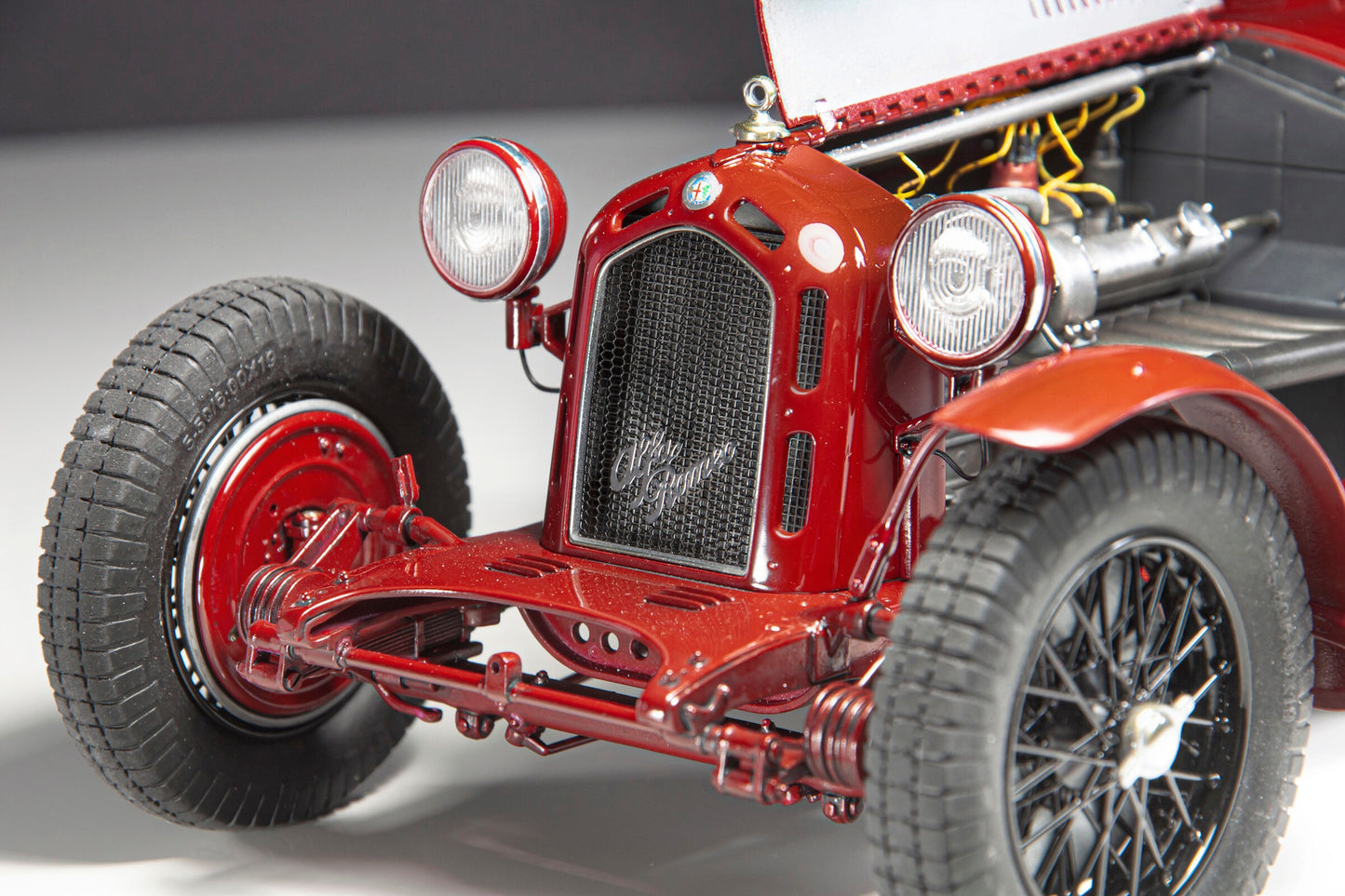
Italeri 4708 - ALFA ROMEO 8C/2300 (1931-1933) 110 ANNIVERSARY 1/12 Scale
Italeri 4708 - ALFA ROMEO 8C/2300 (1931-1933) 110 ANNIVERSARY 1/12 Scale
SKU:ITA4708
Regular price
$156.00 USD
Regular price
$311.99 USD
Sale price
$156.00 USD
Unit price
per
Shipping calculated at checkout.
Couldn't load pickup availability
Product features
Product features
Italeri 4708 – Alfa Romeo 8C 2300 Roadster – 1:12 Scale Model Kit
A Racing Car With License Plates
The Alfa Romeo 8C 2300 was one of the greatest sports cars of the 1930s.
It was fast, technically advanced and successful in nearly every important European road race. It was also available through Alfa Romeo dealers to private customers—provided those customers possessed sufficient money, courage and tolerance for wind noise.
Introduced in 1931, the 8C 2300 combined genuine competition engineering with elegant two-seat bodywork. Racing versions conquered the Targa Florio, Mille Miglia, Italian Grand Prix and four consecutive editions of the 24 Hours of Le Mans.
Italeri’s impressive 1:12 scale kit recreates the open two-seat Roadster: less specialized than the Monza racer, but still unmistakably descended from a machine built to cross Sicily before lunch.
Eight Cylinders and a Supercharger
“8C” referred to the eight-cylinder engine. “2300” referred to its approximate displacement. Marketing departments were apparently much smaller in 1931.
Designed under legendary engineer Vittorio Jano, the 2,336cc straight-eight used two four-cylinder blocks joined by a central gear train. This arrangement drove the twin overhead camshafts and the Roots-type supercharger while reducing the length and torsional stress of the crankshaft.
Depending upon specification, the 8C 2300 produced approximately 142 to 155 horsepower. That may sound modest today, but it was delivered through a lightweight chassis, narrow tires and a driving position equipped with very little between the driver and the scenery.
Built to Win Almost Everywhere
The 8C 2300 made its competition debut in 1931 and immediately began collecting victories.
Tazio Nuvolari won the Targa Florio in an 8C 2300. Giuseppe Campari and Nuvolari won the Italian Grand Prix at Monza, leading to the competition version becoming known as the 8C 2300 Monza.
The model also won the Mille Miglia in 1932 and 1933 and dominated Le Mans from 1931 through 1934. During this period, many Alfa Romeos were prepared and entered by Scuderia Ferrari—before Ferrari manufactured its own cars and complicated the matter considerably.
Approximately 188 examples of the 8C 2300 were produced between 1931 and 1934. Road-going versions allowed fortunate private owners to enjoy much of the competition car’s engineering without having to enter the Targa Florio every time they wanted a ride.
More Than 350 Parts in 1:12 Scale
Italeri’s large multimedia kit includes 320 plastic parts and 30 chrome-plated components, together with photo-etched details, rubber tires, metal screws, tubing, cord and nylon mesh.
The completed model measures approximately 32 cm, or 12.6 inches, in length. At this scale, the 8C’s engineering becomes a major part of the display rather than something vaguely suggested beneath an immovable bonnet.
Construction begins with the substantial ladder chassis and continues through the suspension, axles, drivetrain, engine, cockpit and bodywork. Many of the principal assemblies are attached with the supplied screws, providing secure connections and giving the project a suitably mechanical character.
The Straight-Eight on Display
The long bonnet opens to reveal a highly detailed recreation of the supercharged straight-eight engine.
The kit provides separate engine blocks, camshaft housings, supercharger, intake and exhaust components, gearbox and accessory details. Flexible tubing and additional fittings reproduce the prominent plumbing that gave early competition engines the appearance of machinery designed by someone with strong opinions about copper pipe.
Careful painting can distinguish the cast-metal surfaces, polished components, brass fittings, wiring and rubber hoses. The engine and surrounding chassis remain highly visible with the cowling raised, rewarding builders who enjoy detailed mechanical finishing.
Closing the bonnet is also possible, although it does conceal much of the work.
A Complete Chassis Beneath the Body
The 8C’s ladder-frame chassis is reproduced with separate crossmembers, axles, drivetrain and suspension components.
The realistic suspension includes leaf springs, friction dampers and period mechanical details. Steering components allow the front wheels to be positioned, giving the finished model a more natural display stance.
The rear axle, driveshaft, exhaust system and underside fittings are all separately represented. Because the car’s narrow body leaves much of its mechanical structure visible, careful chassis painting and restrained weathering contribute considerably to the finished appearance.
Wire Wheels and Five Rubber Tires
Large wire wheels are among the defining visual features of the 8C 2300.
Italeri provides five detailed rubber tires, including the externally mounted spare. Separate wheel components reproduce the hubs, rims and spokes, while chrome-plated parts are supplied for selected trim and mechanical fittings.
The large scale makes the wheels especially prominent. It also means that alignment matters. Four wheels pointing in approximately the same direction was regarded as a useful feature even in the 1930s.
An Interior From a More Optimistic Age
The open cockpit includes two seats, floor, pedals, gear lever, handbrake, steering column, dashboard and individual instruments.
The separate interior components provide plenty of opportunity for leather tones, wood effects, polished metal and subtle wear. Photo-etched parts add finer details, while the supplied nylon mesh and cord reproduce selected textures that would be difficult to capture convincingly in molded plastic.
The finished cockpit reflects the Roadster’s dual personality: elegant enough for touring, but sufficiently purposeful to remind the passenger that the engine was developed for racing.
A windscreen was provided. Everything above it remained the responsibility of the atmosphere.
Kit Highlights
Large 1:12 scale multimedia model kit
Finished length approximately 32 cm / 12.6 in.
320 plastic parts
30 chrome-plated parts
Highly detailed 2,336cc supercharged straight-eight engine
Opening multipart bonnet
Detailed ladder-frame chassis
Realistic suspension and drivetrain
Positionable steering
Five detailed rubber tires
Wire-style wheels with separate components
Complete two-seat Roadster cockpit
Photo-etched detail parts
Metal screws and fasteners
Flexible tubing, cord and nylon mesh
Decal sheet
Full-color assembly and painting instructions
Italeri Skill Level 5
For the Experienced Modeler
With more than 350 plastic and chrome-plated parts, a complete engine, separate chassis and multimedia fittings, this is a substantial project intended for experienced modelers.
The large scale provides excellent opportunities for additional wiring, plumbing, surface finishing and weathering. It also makes careful cleanup, alignment and test-fitting particularly important. The chassis, suspension, body and wheels should be checked throughout construction to ensure that everything meets where 1930s Italian engineering intended.
Assembly and painting are required. Paint, plastic cement, cyanoacrylate adhesive and modeling tools are not included.