Italeri - Dakota Mk.III 1:72 Scale
Italeri - Dakota Mk.III 1:72 Scale
SKU:ITA1338
Regular price
$74.99 USD
Regular price
$37.49 USD
Sale price
$74.99 USD
Unit price
per
Shipping calculated at checkout.
Couldn't load pickup availability
Product features
Product features
Italeri 1:72 Dakota Mk.III – Model Kit to Assemble
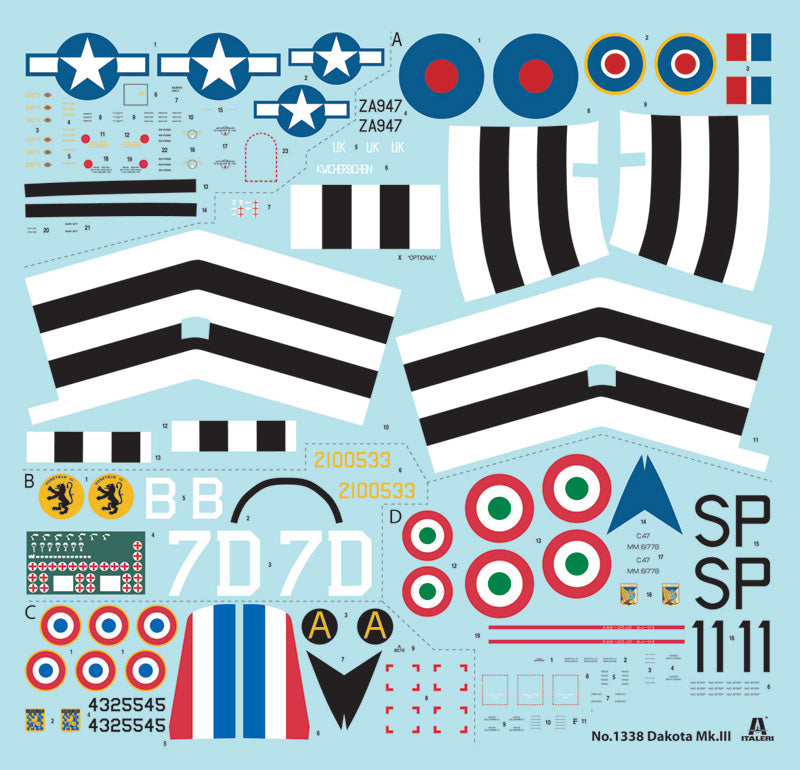
At 1:72 scale, Italeri’s Dakota Mk.III measures 27.2 cm (10.7 inches) long and recreates one of the most important military transport aircraft of World War II. The kit includes detailed aircraft components, a colorful instruction sheet, and a super decal sheet with markings for four different versions, offering modelers the opportunity to reproduce this legendary transport aircraft in a variety of historical configurations.
Developed from the successful Douglas DC-3 airliner, the military Douglas C-47 Skytrain became one of the most widely used transport aircraft of the Second World War. Renowned for its reliability, versatility, and operational durability, it served Allied forces across multiple theaters of war, transporting troops, equipment, supplies, and wounded personnel.
British and Commonwealth-operated versions of the C-47 were known as the Dakota. The Dakota Mk.III represents an important part of this aircraft's military history, reflecting the essential role played by transport aviation in supporting Allied operations. Italeri’s scale model captures the distinctive twin-engine configuration and robust appearance of this famous aircraft.
The Dakota – A Legend of Military Transport Aviation
The Douglas DC-3 first established its reputation as a highly successful commercial transport aircraft during the 1930s. Its combination of reliability, range, and passenger capacity made it one of the most influential aircraft in the development of modern air transport.
As the international situation deteriorated during the late 1930s and the Second World War began, military planners recognized the potential of the DC-3 design for transporting troops and supplies. The aircraft's proven performance and practical construction made it an ideal foundation for a dedicated military transport.
The United States developed the military C-47 Skytrain, adapting the DC-3 for the demanding requirements of military operations. The aircraft became a central component of Allied logistical networks, operating across Europe, North Africa, the Mediterranean, Asia, and the Pacific.
British and Commonwealth forces adopted the name Dakota for their C-47 aircraft. These transports became indispensable for moving personnel, delivering supplies to forward positions, evacuating casualties, and supporting airborne operations.
Unlike fighters and bombers, whose roles were often measured by their performance in direct combat, the Dakota contributed to the war effort by ensuring that troops and equipment reached the places where they were needed.
Its ability to perform a wide range of missions made it one of the most valuable and recognizable transport aircraft of the Second World War.
From the DC-3 to the Military C-47
The conversion of the DC-3 into the C-47 Skytrain demonstrated how a successful civilian aircraft could be adapted to meet the demands of modern warfare.
The military version incorporated changes intended to support transport operations, including provisions for carrying military cargo and personnel. Its rugged construction and twin-engine layout made it suitable for frequent operations under demanding conditions.
The C-47 was powered by two Pratt & Whitney R-1830 Twin Wasp radial engines, each producing approximately 1,200 horsepower. According to Italeri, the Dakota could reach a maximum speed of approximately 360 km/h (224 mph) and carry a payload exceeding 2,500 kg (5,512 lb).
These capabilities allowed the aircraft to transport personnel, ammunition, medical supplies, food, and other essential equipment. Its cargo capacity and operational flexibility made it an important link between rear-area bases and military forces deployed closer to the front.
The aircraft's twin-engine configuration also provided the performance necessary for long-distance transport missions, while its established design helped support widespread production and operation.
The Dakota's success was not based on a single outstanding characteristic but on the combination of practical engineering, dependable performance, and adaptability to different military requirements.
Italeri’s 1:72 scale model recreates this historic transport aircraft, making it an excellent choice for collectors interested in military aviation and the logistical foundations of Allied victory.
A Workhorse of the Allied War Effort
The Dakota was used extensively by Allied forces throughout the Second World War. Its versatility allowed it to support operations ranging from routine supply flights to major airborne assaults.
Transport aircraft were essential to the functioning of modern armies. Frontline troops required a continuous flow of ammunition, food, medical equipment, fuel, and replacement personnel. The Dakota helped move these resources across considerable distances and into areas where ground transportation was difficult or vulnerable.
The aircraft could also be configured to transport military personnel and paratroopers. In airborne operations, Dakotas carried soldiers to designated drop zones, where they parachuted into combat areas to secure objectives, disrupt enemy movements, or support advancing ground forces.
Other missions included the delivery of cargo by parachute, the movement of specialized equipment, and the evacuation of wounded personnel from operational areas.
The Dakota's contribution was often less visually dramatic than that of a fighter aircraft, but its impact was fundamental. Airborne forces could not operate on a large scale without dependable transport aircraft, and ground formations depended on efficient logistical support to maintain their momentum.
The aircraft became a symbol of the importance of transport aviation in modern warfare, demonstrating that the ability to move men and supplies could be as important as the ability to deliver weapons.
Operation Overlord and the Allied Airborne Assaults
One of the most famous roles of the C-47 and Dakota was supporting Allied airborne operations during the liberation of Western Europe.
On June 6, 1944, Allied forces launched Operation Overlord, the invasion of Normandy. Alongside the amphibious landings, airborne troops were deployed behind German defensive positions to secure important roads, bridges, and other strategic objectives.
C-47 Skytrains and Dakotas transported paratroopers toward their designated drop zones during the night preceding the main landings. These missions were complex and dangerous, requiring crews to navigate through darkness, weather conditions, and enemy defenses while maintaining formations over unfamiliar territory.
Transport aircraft also supported subsequent airborne operations, delivering reinforcements and supplies to forces operating behind enemy lines.
Later in 1944, Allied airborne operations continued as the campaign moved deeper into occupied Europe. The Dakota remained important because it could carry troops and cargo in substantial numbers, helping sustain the operational tempo of Allied forces.
The aircraft's association with these historic operations has made it one of the most recognizable transport aircraft of the Second World War.
For military aviation enthusiasts, the Dakota offers an opportunity to recreate an aircraft connected not only to logistical missions but also to some of the most significant events of the Allied campaign in Europe.
The Dakota Mk.III – British and Commonwealth Service
The Dakota designation became closely associated with C-47 aircraft operated by the Royal Air Force and other Commonwealth air forces. These aircraft performed a wide variety of transport and support missions during the war.
The Dakota Mk.III formed part of this broader family of military transports, serving in an environment where reliability and flexibility were essential. Transport aircraft frequently operated on demanding schedules, carrying personnel and supplies between bases, staging areas, and operational zones.
Their missions could involve transporting paratroopers, delivering cargo, moving military equipment, and evacuating casualties. Depending on the operational situation, an aircraft might be assigned to routine logistics one day and a major airborne operation the next.
The Dakota's ability to undertake these different tasks made it a valuable asset to British and Commonwealth forces. Its established design and dependable performance helped maintain the flow of supplies and personnel required for sustained military operations.
The aircraft's history also illustrates the international nature of Allied aviation during World War II. Although the basic design originated in the United States, it was operated by numerous Allied air forces and became an important part of their combined war effort.
Italeri’s model includes decals for four different versions, giving modelers the opportunity to explore alternative historical markings and represent the Dakota in different service configurations.
Designed for Reliability and Operational Flexibility
The Dakota's reputation rested on its straightforward and durable design. Its twin radial engines, conventional configuration, and practical fuselage made it suitable for the repeated transport missions that defined its military career.
The aircraft's interior could accommodate personnel or cargo, depending on the mission. This adaptability allowed operators to use the same basic aircraft for different logistical requirements without needing a specialized platform for every task.
Its twin-engine arrangement provided the power needed to transport substantial loads, while its maximum speed of approximately 360 km/h gave it the ability to cover operational distances efficiently for a transport aircraft of its era.
The Dakota was also valued for its ability to operate in a variety of environments. Military airfields could be busy, temporary, or located relatively close to active combat zones, placing considerable demands on aircraft and ground crews.
The aircraft's long service life demonstrated the effectiveness of a design that prioritized practical utility over unnecessary complexity.
Although it was not designed as a combat aircraft, the Dakota operated in wartime conditions where enemy action, weather, and demanding flight schedules presented real risks.
Its success helped establish the C-47 and Dakota family as one of the defining military transport designs of the twentieth century.
A Lasting Legacy Beyond World War II
The Dakota's importance did not end with the conclusion of World War II. Its rugged construction, dependable engines, and adaptable design allowed it to remain in service for many years after the conflict.
In the postwar period, aircraft from the C-47 family continued to perform transport, supply, passenger, and support missions for military and civilian operators around the world.
The aircraft's versatility made it useful in environments where a dependable transport was more important than advanced speed or sophisticated equipment. Its ability to carry personnel and cargo continued to prove valuable as military and civilian aviation developed.
Few transport aircraft have achieved the same level of recognition or maintained such a long operational history. The Dakota became an enduring symbol of the role played by transport aviation in connecting bases, supporting ground forces, and enabling complex military operations.
For collectors, this extended service history adds another dimension to the aircraft's appeal. The Dakota can represent the wartime logistical networks of the Allies as well as the continued use of proven aircraft designs in the decades that followed.
Italeri’s Dakota Mk.III offers modelers an opportunity to celebrate this legacy through a detailed scale representation of one of the most influential transport aircraft in aviation history.
A Distinctive Subject for Aircraft Modelers
The Dakota Mk.III is an excellent subject for modelers interested in transport aircraft, Allied aviation, and the logistical side of the Second World War.
Its recognizable twin-engine layout, rounded nose, high-mounted cockpit windows, and long fuselage distinguish it from conventional fighters and bombers. The aircraft's practical appearance reflects its purpose: moving people and equipment efficiently rather than engaging enemy aircraft in combat.
At 27.2 cm (10.7 inches) long, the completed model offers a substantial display presence while remaining suitable for a typical aircraft collection.
The fuselage windows, cockpit glazing, radial engines, propellers, and landing gear provide a variety of features for careful assembly and finishing. The large wings and fuselage also offer opportunities to work with historical paint schemes and markings.
The included super decal sheet provides markings for four versions, allowing collectors to select a preferred configuration and explore different interpretations of the aircraft's service history.
Modelers may choose to display the Dakota in a clean transport configuration or use restrained weathering to suggest an aircraft that has completed repeated supply or personnel transport missions.
Whether displayed alongside Allied fighters, bombers, gliders, or other transport aircraft, the Dakota Mk.III makes an important addition to a World War II aviation collection.
Kit Features and Specifications
Manufacturer: Italeri
Manufacturer's item number: 1338
Aircraft: Douglas Dakota Mk.III
Scale: 1:72
Finished length: 27.2 cm (10.7 inches)
Aircraft type: Twin-engine military transport aircraft
Historical period: World War II
Country of origin: United States
Service operators: Royal Air Force and Commonwealth air forces, among others
Engines: Two Pratt & Whitney R-1830 Twin Wasp radial engines
Maximum speed: Approximately 360 km/h (224 mph)
Payload capacity: More than 2,500 kg (5,512 lb), according to Italeri's product description
Skill level: 3 – Intermediate
Decals: Markings for 4 versions
Instructions: Color assembly instructions
Suggested paints: Includes manufacturer-recommended colors for finishing the model.
Construction: Plastic model kit to assemble.
Figures: Not included.
An Essential Addition to a World War II Aviation Collection
The Dakota Mk.III is an excellent choice for collectors interested in Allied military aviation, transport aircraft, and the history of airborne operations during World War II.
Its contribution to the Allied war effort extended far beyond conventional transport duties. By moving paratroopers, delivering supplies, evacuating wounded personnel, and supporting military operations across multiple theaters, the Dakota helped provide the logistical foundation on which many Allied operations depended.
At 1:72 scale, Italeri’s model offers a practical balance between display size and recognizable detail. Its 27.2 cm length makes it suitable for a dedicated transport aircraft display or a broader collection of historical military aircraft.
The four decal options provide flexibility for modelers who want to explore different markings and service configurations. Combined with the aircraft's rich operational history, these options make the Dakota an engaging project for both aviation enthusiasts and experienced model builders.
Whether you are building a collection dedicated to Operation Overlord, British and Commonwealth aviation, or the development of military transport aircraft, the Italeri Dakota Mk.III represents one of the most important aircraft of the Second World War.
Assembly and Painting Information
This product is a plastic model kit that requires assembly and painting. It is supplied unassembled and is not a finished display aircraft.
Paints, modeling glue, and tools are not included unless specifically stated by the manufacturer. Please consult the included color instructions for assembly guidance, recommended paint colors, and decal placement.
Please note: Figures are not included with this kit.
The manufacturer rates this kit at Skill Level 3. It is suitable for modelers with some assembly experience who are interested in recreating a historic military transport aircraft.