Italeri - U-Boot Biber Midget Submarine 1:35 Scale
Italeri - U-Boot Biber Midget Submarine 1:35 Scale
SKU:ITA5609
Regular price
$34.99 USD
Regular price
$69.99 USD
Sale price
$34.99 USD
Unit price
per
Shipping calculated at checkout.
Couldn't load pickup availability
Product features
Product features
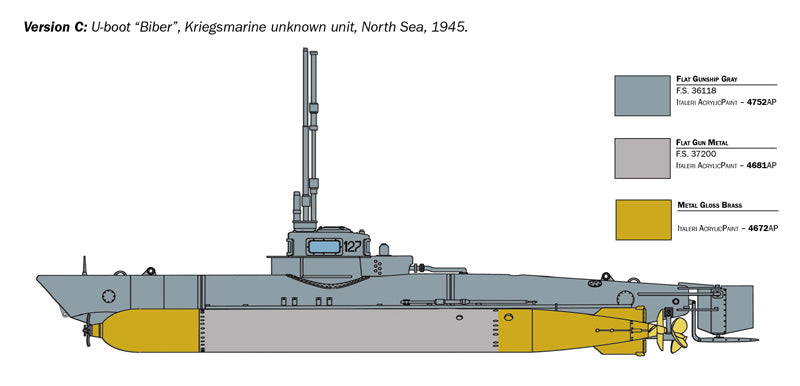
At 1:35 scale, Italeri’s Biber Midget Submarine measures 18.6 cm (7.3 inches) long and recreates one of the most unusual naval weapons developed by Germany during World War II. The kit includes photo-etched metal details, two crew figures, colorful assembly instructions, and decals for three different versions.
Small, compact, and designed for covert coastal operations, the Biber was a single-person submarine developed by the German Kriegsmarine during the final years of the war. Armed with external torpedoes or mines, it was intended to threaten Allied shipping and help defend German-controlled coastlines against an increasingly likely invasion.
Italeri brings this remarkable miniature submarine to life in a detailed scale model that captures the unusual engineering and desperate strategic circumstances behind one of Germany’s final wartime naval projects.
Small Submarine. Serious Mission.
The German word Biber means “beaver”—an unexpectedly peaceful name for a weapon designed for underwater attacks.
The Biber belonged to a category of naval weapons known as midget submarines: compact vessels designed to carry a single operator and attack enemy ships in coastal waters.
Unlike conventional submarines, which were built for extended patrols and independent operations, the Biber was intended for relatively short missions close to enemy-controlled shores.
Its compact dimensions allowed it to operate in shallow coastal environments where larger submarines faced greater limitations. Its small size, however, came at a considerable cost in terms of crew comfort, operational endurance, and survivability.
Measuring approximately 9 meters in full size, the original Biber had a maximum surfaced speed of around 6.5 knots and could reach approximately 5.3 knots underwater.
Italeri’s 1:35 scale model reproduces this distinctive vessel in a compact display size, making it an excellent subject for collectors interested in unusual naval engineering and specialized World War II weapons.
A Compact Model Full of Character
At just 18.6 cm (7.3 inches) long, the finished model offers a detailed representation of a vessel whose unusual design makes it stand out among conventional submarine models.
The Biber’s narrow hull, small conning tower, external weapon arrangement, and distinctive silhouette reflect its specialized mission.
Kit features include:
• Detailed Biber midget submarine hull
• Distinctive conning tower and observation equipment
• External weapon mounting details
• Propulsion and stern assembly details
• Photo-etched metal components for finer detailing
• Two included crew figures
• Decals for three different versions
• Color assembly instructions
The photo-etched components provide additional fine detailing, while the included figures help establish the scale of this unusually small submarine.
The three marking options also offer opportunities to explore different finishes and camouflage schemes associated with the vessel.
Whether displayed independently or incorporated into a larger naval diorama, the Biber makes an unusual addition to a World War II model collection.
Designed for Covert Coastal Operations
The Biber was developed around a very specific tactical requirement: delivering a small crew and a limited weapons load close to enemy shipping without exposing a large submarine to the same operational demands.
Its armament consisted of two externally mounted 530 mm torpedoes or two mines, depending on the configuration.
External weapon mounting allowed the submarine to carry its weapons without requiring the internal space and launch systems associated with conventional submarine torpedo tubes.
The vessel was operated by a single crew member, who was responsible for navigation, observation, and the execution of the mission.
This compact arrangement reduced the size and complexity of the craft but created significant challenges. The operator had limited space, endurance was restricted, and the submarine offered little protection if detected by enemy forces.
The Biber was therefore a specialized weapon designed around surprise and proximity rather than speed, endurance, or sustained underwater combat.
Italeri’s model captures the distinctive appearance of this approach to naval warfare, making it an interesting project for modelers who appreciate engineering solutions developed under extreme wartime pressure.
The Historical Story of the Biber
By 1944, Germany’s naval position had deteriorated significantly. Allied forces were advancing across occupied Europe, German surface operations were increasingly constrained, and the possibility of an Allied invasion of German-controlled territory had become a central strategic concern.
The Kriegsmarine sought ways to threaten Allied shipping and strengthen coastal defenses without relying exclusively on conventional submarines and major surface vessels.
Small attack craft offered a potential solution. They required fewer resources than larger warships and could be designed specifically for operations in narrow coastal waters.
The Biber emerged from this environment as one of Germany’s attempts to develop a compact submarine suitable for defensive coastal missions.
Rapid Development in 1944
The Biber’s development began in February 1944, and the first examples entered the water approximately six months later.
This exceptionally short development period reflected the urgency of Germany’s military situation during the final stages of the war.
The design emphasized simplicity and compact dimensions, allowing the submarine to be produced and deployed without the extended development process associated with larger and more sophisticated naval vessels.
However, rapid development also brought limitations. The Biber’s small size restricted its endurance and made operating the vessel physically demanding for its single crew member.
Despite these disadvantages, the program proceeded, and the Kriegsmarine eventually received and operated more than 300 Bibers between 1944 and the end of the war.
A Weapon Intended to Defend the Coast
The Biber’s principal strategic purpose was to help defend German-controlled coastlines against Allied naval forces and shipping.
Its operating concept relied on approaching enemy vessels in coastal waters and launching torpedoes or laying mines before withdrawing.
In theory, numerous small submarines operating in suitable locations could complicate Allied naval movements and threaten ships supporting amphibious operations.
In practice, the Biber’s limited endurance, technical problems, and the difficulties of conducting underwater operations under combat conditions restricted its effectiveness.
The vessel illustrates the challenges faced by a navy attempting to counter a stronger opponent with increasingly limited resources.
Operational Limitations and Wartime Reality
The Biber’s compact design was both its defining advantage and one of its greatest weaknesses.
Its small size made it suitable for specialized missions, but it also limited the equipment that could be carried and placed considerable demands on the operator.
Underwater visibility, navigation, endurance, and the ability to detect and engage enemy vessels were all important challenges for a single-person submarine.
The Biber therefore never represented a replacement for conventional submarines. Instead, it was an experimental and specialized addition to Germany’s broader coastal warfare efforts.
Its development demonstrates how military technology can be shaped by urgency: a weapon may be relatively simple to manufacture and deploy while still facing substantial limitations in actual combat.
The Biber and the Evolution of Naval Warfare
The Biber belongs to a broader history of specialized naval weapons developed to overcome the limitations of conventional fleets.
During both World Wars, several navies experimented with compact submarines, human-operated torpedoes, explosive motorboats, and other weapons designed for attacks in confined waters.
These systems often emphasized surprise and low production costs rather than the endurance and versatility of larger vessels.
Germany’s Biber program reflected this approach during the final phase of World War II, when conventional naval operations had become increasingly difficult.
Although the Biber had significant operational limitations, it remains an interesting example of the engineering and tactical experimentation that characterized wartime naval development.
For military history enthusiasts, the Biber provides an opportunity to explore a lesser-known aspect of the Kriegsmarine and the increasingly specialized weapons employed during the final years of the conflict.
A Distinctive Subject for Naval Modelers
The Biber’s unusual proportions and external weapon arrangement make it particularly appealing to modelers looking for something different from a traditional submarine.
Its compact size allows it to fit comfortably into a display cabinet, while its detailed hull and conning tower provide opportunities for careful painting and finishing.
The camouflage schemes and marking options can also help distinguish the finished model from more conventional naval subjects.
Modelers may choose to emphasize the vessel’s operational appearance through subtle weathering, paint fading, and restrained effects around the hull and external fittings.
The included crew figures help establish the scale of the submarine and can add further historical context to the finished display.
Whether displayed on its own or as part of a broader naval collection, the Biber offers a fascinating look at a specialized weapon developed during one of the most demanding periods in German naval history.
Kit Highlights
Scale: 1:35
Finished length: 18.6 cm (7.3 inches)
Construction: Plastic model kit to assemble
Detail parts: Photo-etched metal components
Included figures: 2 crew figures
Markings: Decals for 3 versions
Instructions: Color assembly instructions
Historical period: World War II
Country: Germany
Manufacturer: Italeri
Manufacturer’s item number: 5609
Skill level: 3 – Intermediate
Assembly, painting, tools, and adhesives are required. Paint and glue are not included.