Italeri - LCM 3 Landing Craft Mechanized 1:35 Scale
Italeri - LCM 3 Landing Craft Mechanized 1:35 Scale
SKU:ITA6755
Regular price
$44.99 USD
Regular price
$89.99 USD
Sale price
$44.99 USD
Unit price
per
Shipping calculated at checkout.
Couldn't load pickup availability
Product features
Product features
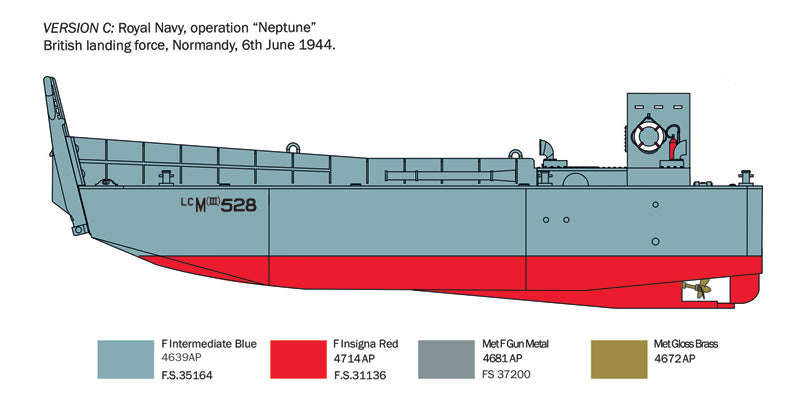
At 1:35 scale, Italeri's LCM 3 landing craft measures an impressive 43.5 cm (17.1 inches) long, recreating one of the most recognizable amphibious assault vessels of World War II. The kit includes three crew figures, decals for four marking options, and color assembly instructions.
Designed to transport troops, equipment, and even a medium tank directly from ship to shore, the LCM 3 played a vital role in Allied amphibious operations. Its practical design and large forward loading ramp made it an essential component of the landings that helped shape the course of the war.
Simple in appearance but remarkable in its purpose, Italeri's LCM 3 brings to life a vessel that helped bridge the gap between naval power and ground combat.
A Landing Craft Built for the Battlefield
During World War II, transporting soldiers and heavy equipment from ships to hostile shores presented one of the greatest challenges in amphibious warfare.
Conventional ships could not approach shallow beaches closely enough to unload tanks and vehicles directly. The solution was a specialized landing craft capable of carrying troops and equipment through shallow coastal waters and delivering them directly onto the shore.
The Landing Craft, Mechanized (LCM) was developed to meet this requirement. Its practical design prioritized cargo capacity, a shallow draft, and a bow ramp that could be lowered to allow vehicles and soldiers to disembark quickly.
The LCM 3 became one of the most recognizable American landing craft variants of the war. It could transport a fully equipped infantry squad or carry a medium tank weighing approximately 30 tons, including the M4 Sherman under suitable loading conditions.
Its maximum speed was approximately 8 knots, reflecting its role as a transport vessel rather than a fast combat ship.
Italeri's 1:35 scale model recreates this utilitarian military craft, capturing the distinctive hull, open cargo area, and large front ramp that made the LCM 3 such an effective amphibious transport.
A Large Model with Functional Character
Measuring 43.5 cm (17.1 inches) in length, the completed model offers an impressive display presence while providing plenty of room for detailed painting and weathering.
The LCM 3's straightforward construction makes it a particularly interesting subject for modelers who appreciate military engineering, amphibious operations, and historical dioramas.
Model features include:
• Detailed hull inspired by the original LCM 3 landing craft
• Large forward loading ramp, characteristic of the vessel's amphibious role
• Open cargo deck for recreating troop and vehicle transport scenes
• Detailed deck structures and fittings
• Crew and defensive equipment details
• Three included crew figures
• Decals for four different marking options
• Color assembly instructions
The large cargo area provides an excellent foundation for a customized display. Modelers can emphasize the vessel's transport role or incorporate it into a broader amphibious landing scene featuring infantry, military vehicles, obstacles, and beach terrain.
At 1:35 scale, the LCM 3 also fits naturally into collections of World War II military vehicles and figures, making it particularly suitable for integrated land-and-sea dioramas.
Designed Around the Mission
Unlike a conventional warship, the LCM 3 was built primarily to deliver its cargo safely and efficiently.
Its large bow ramp allowed troops to disembark directly onto the beach and enabled vehicles to drive off the craft without requiring a harbor or specialized unloading facilities.
The hull's practical layout provided space for cargo while maintaining the shallow draft necessary for approaching shorelines. Its relatively light construction and limited armament reflected its primary purpose: transportation under combat conditions.
The vessel's crew was responsible for navigation, operation, and close defense. Protection was limited, meaning that successful missions depended heavily on coordination with the wider amphibious force and the suppression of enemy resistance around the landing area.
These design priorities are reflected in the model's open cargo space, prominent bow ramp, and straightforward structural layout.
For modelers, the LCM 3 offers a different perspective on military equipment: rather than focusing on firepower or armor, it highlights the engineering required to move troops and heavy machinery from the sea onto the battlefield.
The LCM 3 in World War II
The history of the LCM 3 is closely connected to the Allied development of large-scale amphibious warfare.
At the beginning of World War II, military planners recognized that defeating Axis forces in occupied territories would require more than naval bombardment and conventional troop transports. Armies needed a reliable way to bring infantry, artillery, supplies, and armored vehicles directly onto contested coastlines.
Landing craft became an essential part of this strategy, allowing amphibious forces to establish beachheads even when suitable ports were unavailable or heavily defended.
From Anzio to Normandy
Allied amphibious operations in the Mediterranean demonstrated the importance of landing craft in transporting men and equipment from ships to shore.
During the invasion of mainland Italy, including the landings at Anzio in January 1944, amphibious transport played an important role in establishing and sustaining Allied forces on the Italian coast.
Later that year, the Allied landings in Normandy on June 6, 1944, demonstrated amphibious warfare on an unprecedented scale. Thousands of vessels supported the invasion, carrying soldiers, vehicles, ammunition, fuel, and other essential supplies across the English Channel.
Landing craft such as the LCM were part of the broader logistical system that made these operations possible. Their ability to carry heavy equipment directly to the beaches helped turn initial landings into sustained military campaigns.
The success of an amphibious assault depended not only on the soldiers fighting ashore but also on the continuous movement of equipment and supplies from the sea.
Carrying the Weight of an Invasion
One of the LCM 3's most important capabilities was its ability to transport a medium tank such as the M4 Sherman.
Delivering armored vehicles directly onto a beach gave Allied forces the opportunity to establish mobile fire support and strengthen their positions as they moved inland.
The craft could also transport infantry, allowing soldiers to disembark alongside other elements of an amphibious force.
This versatility made the LCM 3 a valuable component of amphibious logistics. It could support a range of missions without requiring the infrastructure associated with conventional ports.
Its modest speed and limited protection were accepted trade-offs for the cargo capacity and operational flexibility it offered.
The LCM 3 was not designed to win a naval engagement by itself. Its importance lay in enabling the troops and equipment that would fight the battle on land to reach their destination.
Engineering Behind the LCM 3
The LCM 3 illustrates the practical engineering philosophy that characterized many successful military transport vehicles of World War II.
Rather than pursuing high speed or heavy armor, its designers concentrated on cargo capacity, ease of loading, and the ability to operate close to shore.
The bow ramp was central to this concept. When lowered onto a suitable beach, it provided a direct route for personnel and vehicles to leave the craft.
The shallow-draft configuration helped the vessel approach coastal areas inaccessible to larger ships, while its diesel propulsion provided the power needed for relatively short transport journeys between ships and landing zones.
Its design also reflected the realities of amphibious warfare: equipment had to be moved quickly, often under difficult conditions, and the craft needed to be practical to operate as part of a much larger fleet.
The LCM 3 became an enduring symbol of the logistical ingenuity that supported Allied amphibious operations throughout World War II.
A Natural Choice for Military Dioramas
Thanks to its large scale and recognizable silhouette, the LCM 3 is an excellent subject for modelers interested in recreating historical amphibious landings.
Its open cargo deck offers numerous possibilities for display arrangements, from an empty craft approaching the shore to a fully staged scene with soldiers and military vehicles preparing to disembark.
The model can also be combined with other 1:35 scale subjects, including American infantry, armored vehicles, military trucks, and beach defenses.
Weathering techniques can further emphasize the craft's operational character. Subtle paint fading, scuff marks, rust effects, and variations in the finish can help reproduce the appearance of a vessel exposed to saltwater, cargo handling, and repeated beach operations.
Whether displayed independently or incorporated into a larger Normandy or Mediterranean diorama, the LCM 3 offers an opportunity to represent an often-overlooked but essential part of World War II military history.
Kit Highlights
Scale: 1:35
Finished length: 43.5 cm (17.1 inches)
Product type: Military landing craft model kit
Construction: Plastic model kit to assemble
Included figures: 3 crew figures
Markings: Decals for 4 versions
Instructions: Color assembly instructions
Historical period: World War II
Country represented: United States
Manufacturer: Italeri
Manufacturer's item number: 6755
Skill level: 4 – Advanced
Assembly, painting, tools, and adhesives may be required. Paint and glue are not included unless otherwise specified by the manufacturer.