Italeri - 1:12 Bugatti Type 35B - Targa Florio '28 / Monaco GP '30
Italeri - 1:12 Bugatti Type 35B - Targa Florio '28 / Monaco GP '30
SKU:ITA4716
Couldn't load pickup availability
Product features
Product features
Italeri Bugatti Type 35B — Targa Florio 1928 / Monaco Grand Prix 1930 — 1:12 Scale Model Kit
Some racing cars become famous because they win.
The Bugatti Type 35 became famous because it kept winning.
Introduced in 1924, Ettore Bugatti’s masterpiece combined elegant bodywork, light weight, precise handling, and advanced mechanical engineering in a car designed specifically for competition. During its extraordinary career, the Type 35 family accumulated more than 1,000 victories and won the Targa Florio five consecutive times.
Apparently, once was not considered conclusive.
The Type 35B was among the most powerful versions. Its 2.3-liter straight-eight engine used a Roots-type supercharger to produce approximately 140 horsepower, driving through a four-speed manual transmission. With a lightweight body and chassis, the car could reach approximately 130 mph—an impressive speed in an era when the driver sat above the fuel tank, protected by goggles, a small windscreen, and considerable optimism.
Italeri recreates this landmark racing car in large 1:12 scale with approximately 336 components, including 60 photo-etched parts, opening engine cowls, steerable front wheels, rubber tires, chrome-plated pieces, realistic plumbing, artificial leather, and two historically significant marking options.
The completed model measures just over 12 inches long.
Two Cars. Two Very Different Racing Stories.
The kit offers two versions of the Bugatti Type 35B:
-
No. 58 — Eliška Junková, 1928 Targa Florio
-
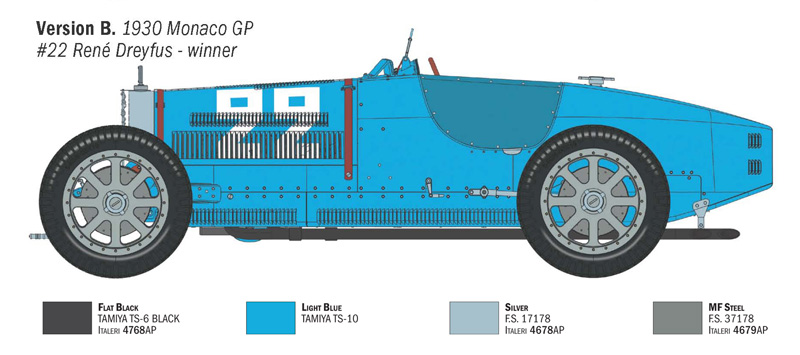
No. 22 — René Dreyfus, 1930 Monaco Grand Prix winner
One won.
The other finished fifth and became legendary anyway.
Eliška Junková — Targa Florio 1928
Eliška Junková arrived in Sicily with an unusually modern approach to racing. She spent weeks studying the Targa Florio’s 67-mile mountain circuit, recording corners, braking points, landmarks, and road conditions.
This was necessary because the course contained roughly 1,400 corners per lap, and drivers completed five laps.
There was no convenient replay available afterward.
Driving her distinctive yellow No. 58 Bugatti Type 35B, Junková challenged the leading factory drivers and held the overall lead during portions of the race. A puncture and water-pump trouble eventually forced her to slow, but she still finished fifth after more than seven hours of competition.
Her performance against Europe’s leading drivers made her the acknowledged star of the event and one of the most celebrated women in early motorsport.
René Dreyfus — Monaco Grand Prix 1930
Two years later, René Dreyfus entered the Monaco Grand Prix in his privately owned blue No. 22 Bugatti Type 35B.
He started tenth.
Ahead of him were the official Bugatti factory cars, including those of Louis Chiron and Guy Bouriat. This ordinarily established the expected finishing order.
Dreyfus declined to observe it.
Over 100 laps of Monaco’s narrow street circuit, he worked his way through the field, set the fastest lap, overtook the factory opposition, and won by 23.8 seconds.
It was one of the defining victories of his career and further evidence that a properly driven Type 35B had little interest in team hierarchy.
The Supercharged Straight-Eight
The long engine bay contains a highly detailed reproduction of Bugatti’s 2,263 cc inline eight-cylinder engine.
The assembly includes the multi-piece engine block, cylinder head, Roots-type supercharger, intake system, exhaust manifold, carburetor, ignition components, separate spark plugs and wires, oil lines, coolant pipes, reservoirs, and associated fittings.
Vinyl tubing, wire, and separate connectors reproduce the plumbing and electrical lines running through the engine compartment. The four-piece engine cowling incorporates finely molded louvers and may be displayed open, allowing the completed powerplant to remain visible.
This is helpful because the engine represents a considerable portion of the project, and concealing it permanently would seem ungrateful.
A Complete Chassis Beneath the Body
The Type 35’s mechanical sophistication extended well beyond its engine.
Italeri begins the model with a full ladder-frame chassis assembled from separate rails and crossmembers. Front and rear axles, leaf springs, friction dampers, steering box, steering linkage, driveshaft, gearbox, differential, brake cables, fuel tank, exhaust system, and other mechanical components are individually represented.
Metal screws reinforce selected structural connections and moving assemblies. The front wheels are designed to steer through the detailed linkage, allowing them to be positioned for a more natural display.
The suspension and underside remain fully modeled even where the finished body makes casual inspection difficult.
Bugatti believed engineering should be beautiful.
Modelers generally believe it should also be present, whether anyone can see it or not.
Bugatti’s Famous Aluminum Wheels
The Type 35 introduced cast aluminum wheels incorporating the brake drums—an advanced solution that reduced unsprung weight and improved brake cooling while making wheel changes faster.
It also gave the car one of the most recognizable wheel designs in automotive history.
The kit reproduces these wheels with sharply defined spokes, integral brake-drum detail, separate hubs, and realistically molded rubber tires. Two spare wheels are included for the Targa Florio configuration, where carrying replacements was advisable on several hundred miles of rough Sicilian mountain roads.
In total, the kit supplies six rubber tires: four for the car and two for the spare wheels.
A Cockpit Designed for Work
The Type 35B’s cockpit was elegant because Bugatti made nearly everything elegant, not because the driver was given unnecessary comforts.
The kit includes a detailed instrument panel with individual gauges, switches, steering wheel, gear lever, handbrake, pedals, seat, cockpit lining, floor, and small windscreen.
New components supplied for this edition reproduce the differences between the two racing versions. Artificial leather material is provided for the seat, hood straps, and spare-wheel retainers, with photo-etched buckles and fasteners adding convincing scale thickness.
The finished interior combines painted metal, wood, leather, and instrument details in a cockpit that remains completely visible.
Air conditioning is not included.
Neither was it included in 1928.
Two Distinctive Finishes
The two versions offer very different visual personalities.
Junková’s Targa Florio car is finished in brilliant yellow with racing number 58 and two externally mounted spare wheels. It is immediately recognizable and makes an especially striking display model.
Dreyfus’s Monaco winner appears in traditional French racing blue with number 22, presenting the Type 35B in its most familiar Grand Prix form.
The kit includes decals for both cars along with a die-cut masking sheet. Builders may use the supplied markings or paint selected numbers and details through the masks for a more authentic period finish.
The extensive color instruction sheet identifies the appropriate finishes for the body, chassis, engine, interior, wheels, and mechanical components.
Multimedia Detail in Large Scale
The included photo-etched fret provides approximately 60 fine metal components for grilles, brackets, straps, fasteners, screens, mechanical details, and cockpit hardware.
Chrome-plated parts reproduce selected bright-metal fittings. Screws strengthen mechanical assemblies, while vinyl tubing and wire add the engine, brake, oil, and fuel connections visible throughout the open chassis.
Artificial leather supplies the straps and upholstered surfaces that plastic alone cannot reproduce convincingly.
The result is a model with the variety of textures expected from an exposed 1920s racing car: painted aluminum, polished metal, leather, rubber, wood, steel, and the occasional component whose purpose becomes apparent only after consulting the instructions again.
Kit Features
-
Large 1:12 scale multimedia model kit
-
Approximately 336 components
-
Approximately 12 inches (30.6 cm) long when completed
-
Bugatti Type 35B racing car
-
Highly detailed 2.3-liter supercharged straight-eight engine
-
Separate supercharger, intake, ignition, and exhaust components
-
Detailed engine plumbing and wiring
-
Four-piece opening engine cowling
-
Full ladder-frame chassis
-
Detailed four-speed transmission and drivetrain
-
Complete front and rear suspension
-
Leaf springs and friction dampers
-
Detailed mechanical brake system and cables
-
Steerable front wheels
-
Six realistic rubber tires
-
Two spare wheels
-
Detailed cast-aluminum-style wheels and brake drums
-
Complete cockpit with instruments and controls
-
Artificial leather for seat, hood straps, and wheel retainers
-
Approximately 60 photo-etched metal components
-
Chrome-plated parts
-
Screws, vinyl tubing, and wire
-
Die-cut painting masks
-
Decals for two historic racing versions
-
No. 58 Eliška Junková — 1928 Targa Florio
-
No. 22 René Dreyfus — 1930 Monaco Grand Prix winner
-
Full-color assembly and painting instructions
-
Italeri Skill Level 5
This is a complex multimedia kit intended for experienced modelers. Building the chassis square, routing the engine plumbing and brake cables, assembling the working steering, fitting the opening cowls, and applying the external straps will reward careful planning and frequent test-fitting.
The finished model captures more than one of the most beautiful racing cars ever made.
It captures two moments when talent challenged expectation: Eliška Junková leading the world’s most demanding road race and René Dreyfus defeating Bugatti’s own factory team with a privately entered car.
The Type 35B was elegant, sophisticated, fast, and remarkably successful.
In other words, very French—except when it was yellow and driven by a Czech woman through Sicily.
Assembly, paint, and cement are required and sold separately.